
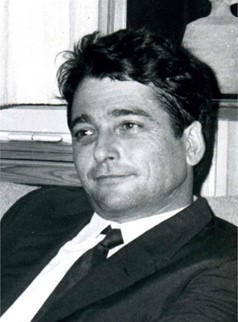
Yoash Vaadia was born in 1931, to a family of Bukharan origin. His grandfather settled in Jerusalem, and his father was one of the first agronomists and established an agricultural farm in Hadera, where Yoash grew up. He began his agricultural education at the Pardes Hanna Agricultural High School.
After his service in the IDF during the War of Independence, he traveled to the University of California, Davis, in 1951 for academic studies. He received his Bachelor’s degree in 1954, his Master’s degree in 1955, and his PhD in 1958. From 1959 to 1962, he was part of the faculty of the Department of Irrigation at UC Davis, engaging in research and teaching. Although he was offered the position of Associate Professor in the Department of Irrigation, he decided to return to Israel and in 1963 joined the Negev Institute for Arid Zone Research in Beersheba.
At the Negev Research Institute, he established the Department of Plant Physiology and focused on research in efficient water use. He directed the Negev Research Institute until he received the role of Head of the Volcani Institute.
Research Areas Plant Physiology
Scientific Achievements He was among the pioneers who examined the importance of cytokinins and abscisic acid in the plant’s response to stresses. Together with Dr. Yishai Sfarim, he published summaries and evaluations in Hebrew and English on a method for directing agricultural research in Israel – examining its application in the citrus branch (1975, 1976), on the BARD fund in Israel (1980) and in the US (1982), and on directing agricultural research for the benefit of society (1997).
His Achievements as Head of the Volcani Institute, Later the Agricultural Research Organization The then Director-General of the Ministry of Agriculture, Ariel Amiad, recognized his skills and in 1968, at the end of Prof. Yitzhak Arnon’s term as Director of the Volcani Institute – the Agricultural Research Station, offered Dr. Yoash Vaadia the position of Director of the Volcani Institute. At the beginning of his management period, he initiated organized work with the help of working groups of senior department heads and created seven research institutes. Concurrently, he created the unified role of “Head of the Organization and Chief Scientist of the Ministry of Agriculture”. He built the researcher grading table and the researcher promotion rank scale, ranks equivalent to university degrees, and established the professional and supreme committees.
When surpluses of vegetables were created in Israeli agriculture in the 1960s, he directed the researchers of the Organization to develop crops and varieties suitable for export. He created the first R&D, Southern R&D, to solve urgent problems in growing tomatoes in greenhouses in the moshavim established in the Besor region, an idea that over the years became a cornerstone in the application of research findings.
Within the framework of discussions on planning agricultural research and development goals in the 1970s, he devoted much attention to the application of research in the citrus branch. With the help of the economist Dr. Yishai Sfarim, a detailed analysis was conducted regarding the yield-contribution to the research and development programs, and the strategy of the branch was determined.
Yoash Vaadia initiated the establishment of the US-Israel Binational Agricultural Research and Development Fund (BARD), which was an action of special importance, from which many researchers from the Volcani Institute and other research institutions benefited, and which continues to operate to a considerable extent to this day. In 1978, he initiated and developed the BARD system, and was on the fund’s management from 1979 to 1992, serving as its General Manager from 1992 until his passing in 1997.
His Activities After Concluding His Role at the Agricultural Research Organization In 1979, Prof. Yoash Vaadia concluded his role as Head of the Agricultural Research Organization. The late Prof. Ram Moav replaced him but served only a short period because he had to resign following an illness. Dr. Yossi Shalhevet, who was the Deputy for Research, filled his place until Prof. Gad Loebenstein was elected to manage the Organization (1981-1986).
In 1980, Prof. Yoash Vaadia moved to the Hebrew University of Jerusalem, where he was appointed Academic Vice President for Administration and Financial Management; he also served as a Professor of Plant Physiology at the university. Within his administrative role, he worked, among other things, on the construction of the university campus buildings on Mount Scopus. The construction plan was significantly delayed and facing budgetary difficulties, and he succeeded in completing the campus ahead of its opening in 1981.
In 1982, he went on a sabbatical in California, at the ARCO Plant Cell Research Institute, and stayed there until 1986, serving as a principal investigator. During this period, he researched the efficiency of water use in wild and cultivated tomato species and published the results of the experiments in the book “Environmental Stress in Plants” (1989).
Upon his return to Israel in 1987, he returned to the position of Vice President of the Hebrew University and Professor of Botany. In his administrative role, he handled, among other things, the severe problems of salaries and pensions of the university’s employees and the operation of the School of Veterinary Medicine.
In 1995 he fell ill and passed away in Davis, California, in December 1997.