
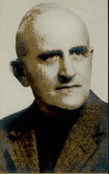
In 1971, Prof. Arnon was awarded the “Israel Prize for Agriculture”.
Yitzhak Aharonovich (with the establishment of the state, he Hebraized his surname to Arnon) was born in Belgium in 1909. He was educated in a Zionist spirit from his youth and studied agriculture at the Higher Agronomic Institute in Gembloux, Belgium. In 1931, he earned the degrees of Agricultural Industries Engineer and Agronomist Engineer. Even as a high school student in 1926, he visited the Land of Israel for the first time. Upon completing his studies, he served in the Belgian army, and in 1932 he got married and immigrated to Israel.
Initially, he worked in several odd jobs, and in 1933 he received the position of Trials Manager at the British Mandate Government’s Agricultural Experiment Station in Acre. As the person in charge of research at the Acre station, he maintained working relations with researchers at the Rehovot Experiment Station, and managed a network of field crop experiments in close cooperation with Jewish growers’ organizations in the Land of Israel. He was later appointed to the position of Inspector of Field Crop Research and served in this role until the station’s closure in 1948, with the end of the Mandate.
In 1948, Arnon transferred the remnants of the Acre station to the Templer settlement of Waldheim, and with the help of the Ministry of Agriculture, established a new experiment station in the area named Neve Ya’ar (later, the Northern Agricultural Research Center). The station in Neve Ya’ar, under his management, initially dealt mainly with field crops, forage, and pasture.
In 1952, he joined the Field Crops Department of the Agricultural Research Station, which was still located in Rehovot, and in 1957 he was appointed Director of the Field Crops Institute in Beit Dagan. In the same year, he received a PhD from the Hebrew University, and was later appointed Professor of Field Crops and Vegetables at the Faculty of Agriculture. In 1958, Dr. Arnon was elected Director of the Agricultural Research Station (Volcani Institute) and served in this position until 1968.
Research Areas Field crops
Scientific Achievements In Hebrew, he published several foundational books intended for farmers, instructors, and students: Field Crops – Theory and Practice (1962), Heredity, Breeding, and Seed Production in Field Crops (1962), Rules for Conducting a Field Experiment (1964), Cotton Growing (1966), and he was also the chief editor of the Encyclopedia of Agriculture.
He presented his views on the organization and management of agricultural research in Israel and in developing countries, as well as his experience in agriculture in arid regions, in English publications, which were received with great interest by international development institutions: 1968 Organisation and administration of agricultural research 1972 Crop production in dry regions 1975 Planning and programming of agricultural research 1981, 1987 Modernization of agriculture in developing countries 1989 Agricultural research and technology transfer 1992 Agriculture in dry lands, principles and practice
Contribution and Public Activity Within and Outside the Research Organization Under his leadership, an attempt was made to integrate the Agricultural Research Station and the Faculty of Agriculture to establish the “National and University Institute of Agriculture,” which operated from 1960 to 1965, but the integration did not come to fruition. Later, he played a central role in establishing a state authority for research and development, and in 1968 the “Katchalsky Report” was submitted, which was an important step towards organizing the Agricultural Research Organization and implementing a research ranking system. As part of his activities within the institution, he operated committees for the promotion and continuing education of researchers and for determining work procedures, and together with the Director General of the Ministry of Agriculture, he established professional committees to determine research directions relevant to growers.
In 1969, he was appointed Director of the Center for Protected Crops Research in Beit Dagan, and concurrently conducted research at the Institute for Rural Planning at the Settlement Study Center in Rehovot. Among other things, he examined the changes that occurred in Arab agriculture in Israel. He was also an esteemed lecturer and consultant at international conferences and institutions, especially in the field of agricultural research organization and the development of arid regions.
In 1971, Prof. Arnon was awarded the “Israel Prize for Agriculture” for his research activities in field crops and breeding, and for his contribution to organizing and initiating large-scale research for the benefit of Israeli agriculture.
Retirement In 1973, Prof. Arnon formally retired, but he continued his activities within the framework of international cooperation and engaged in writing a series of books in which he compiled his extensive professional experience.
In 2000, upon reaching the age of 90, he published a fascinating autobiographical book: “My Life with Plants and Farmers, Memories of an Agronomist in Palestine (Land of Israel), in Israel and Around the World.”
Approaching his 95th birthday in 2004, Dr. Eli Putievsky, Head of the Agricultural Research Organization, presented a certificate of appreciation to Prof. Arnon “upon reaching your golden years, and for your many years of contribution to the Agricultural Research Organization and the advancement of research in Israel.”
Prof. Yitzhak Arnon passed away at a ripe old age in early April 2005.