
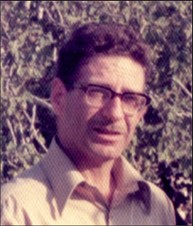
Born in 1929 in Germany, and in 1939 his family immigrated to the Land of Israel. He began his academic studies at the Faculty of Agriculture in 1947, and after a break during the War of Independence, returned to his studies and received a Master’s degree in Agricultural Sciences with honors in 1954, and subsequently completed a PhD in the field of Virology (1960).
Research Areas Plant protection, plant virology
Scientific Achievements In 1953, he was accepted through a tender as a researcher in the Vegetable Department of the Agricultural Research Station in Rehovot. His early works dealt with growing tomatoes for industry and export, and growing sweet potatoes, as well as viral disease problems that affected sweet potatoes. Additionally, he conducted joint research with the Flower Department on viruses in irises, which led to the definition of phenomena related to viral diseases and the selection of virus-free propagation material. In 1960, he established the Virology Department at the Plant Protection Institute, and together with the department members, dealt with viral diseases in vegetatively propagated crops. New characterization methods such as serology and electron microscopy were introduced; viruses in potatoes, strawberries, citrus, and gladioli were characterized, and controlled propagation material was prepared from these crops. He was interested in the physiology of viral diseases, particularly in the emergence of natural resistance to viral diseases, in virus replication inhibitors related to resistance, and in the creation of resistance substances. In the academic field, he began lecturing at Tel Aviv University in 1967 and was appointed Professor of Microbiology in 1973. In 1979, he was appointed Professor at the Faculty of Agriculture. Prof. Loebenstein was a central figure in the development of virology research. In his department, to which he returned after his period of managing the Organization, he engaged in research himself and guided and directed the research team. He was endowed with foresight for future developments and a vision. In this regard, it is worth noting, among his other achievements, the introduction of electron microscopy to the Research Organization.
Contribution and Public Activity Within and Outside the Research Organization In parallel, he was active on an administrative and professional level. In 1967, he was appointed Director of the Plant Protection Institute, serving in this role until 1975. In 1967, he initiated, together with the late Dr. Chaim Shendler and the late Prof. Hanan Oppenheimer, the establishment of the Executive Committee of the Scientific Council, and subsequently served as Chairman of the Executive Committee and as the representative of the Scientific Council in the Organization’s management. In 1981, he was elected to serve as Head of the Agricultural Research Organization and Chief Scientist of the Ministry of Agriculture, working in this position until 1986. He initiated and pushed for the establishment of biotechnological research in the Organization, the introduction of a computerized system, and the establishment of several regional R&Ds. Despite severe budget cuts, he worked to absorb researchers, continue extensive construction in Beit Dagan, establish a Director General’s fund, and strengthen the regional stations. He also initiated the establishment of the Israeli Phytopathological Society and served as its first president, and was involved in publishing the journal Phytoparasitica. He published over 130 scientific articles and about 60 professional articles, and lectured on virology topics at numerous conferences and seminars in international settings. He also served as an advisor for international aid programs, for the development of virus-free sweet potato (in Kenya) and potato (in Kazakhstan) cultivation, and the promotion of agricultural research in Nigeria. For his research activities, he was highly recognized in Israel and abroad – Fellow of the German (1980), American (1988), and Israeli Phytopathological Societies, the Rothschild Prize for Agriculture (1982), and Member of the Kazakhstan Academy of Agricultural Sciences (1996).
Retirement The date of his retirement from the Research Organization was set in 1994, but he continued to work in the laboratory and on summarizing his research, initially on contract, and later as a volunteer. In addition to his book “Plant Virology – Principles and Application” published in 1993, he edited the following books since his retirement: Virus and Virus-like Diseases of Bulb and Flower Crops – 1995 Virus and Virus-like Diseases of Potatoes and Production of Seed-Potatoes – 2001 Virus and Virus-like Diseases of Major Crops in Developing Countries – 2003
Before and after his retirement, he was also involved in public activity and reached the rank of Lieutenant Colonel (Res.) in the IDF. He also served as CEO of the biotechnology company “Serum-Tech” (1995-1998), and as a member of the Board of Directors of the “Yakhin-Hakal” company (1995-2000).
Gad Loebenstein passed away in February 2018, at the age of 89. He was one of the leading researchers at the Agricultural Research Organization. May his memory be a blessing!