
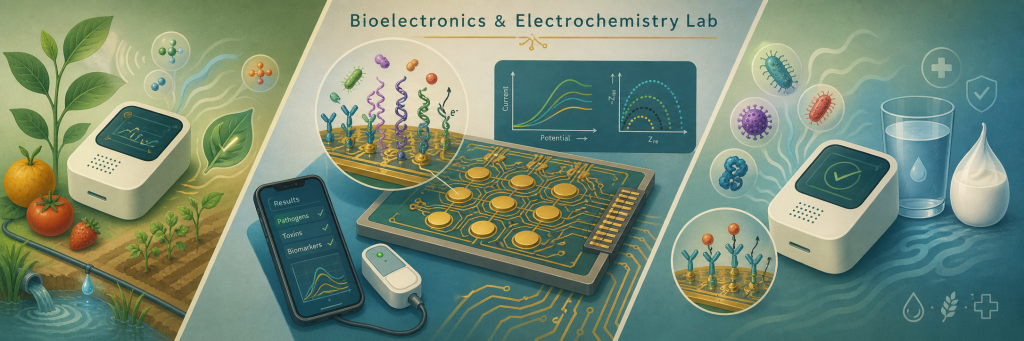
The Bioelectronics and Electrochemistry Lab develops miniaturized bioelectronic and electrochemical sensors for rapid detection of contaminants, pathogens, biomarkers and functional biological signals in agriculture, food safety, environmental monitoring and health-related applications. Our research integrates microfabricated electrochemical chips, nanomaterials, carbon nanotube field-effect transistors, biofunctional interfaces, immunosensors, DNA/RNA biosensors and advanced signal analysis. The lab offers a highly interdisciplinary research environment for students interested in bioelectronics, biosensing, lab-on-chip technologies, electrochemistry, nanotechnology and real-world diagnostic platforms for field and point-of-care application
Requirements:
We are looking for curious, motivated and independent students who are interested in interdisciplinary research combining experimental work, technology development and scientific problem-solving. A background in engineering, biotechnology, chemistry, biology, materials science, nanotechnology, electrochemistry or related fields is an advantage. Candidates should have good teamwork skills, the ability to learn independently, attention to experimental detail, basic data-analysis capabilities and a strong interest in developing innovative sensing technologies with practical applications in agriculture, environmental monitoring, food safety and health-related diagnostics
Students will gain hands-on experience in bioelectronics, electrochemistry, micro- and nanofabrication, nanomaterials, and biosensor development. They will learn to design, functionalize, and characterize miniaturized chip-based sensing platforms, including microelectrodes, gold electrode arrays, carbon nanotubes, ion-selective membranes, and biointerfaces based on antibodies, enzymes, DNA/RNA, aptamers, or receptors. They will also work with advanced tools and methods such as potentiostats, multichannel electrochemical systems, Electroanalytical techniques, optical/fluorescence microscopy. students may also gain experience in microfluidics, bioprinting, signal processing, and data analysis
See yourself fit? send your CV to Dr. Sefi Vernick via sefi@volcani.agri.gov.il